Belarusian playwriting: themes, forms, generations
Kseniya Knyazeva: Let’s start with your experience as a reader. For five years you were a reader for the festival-laboratory of contemporary Belarusian playwriting WriteBox. How would you define the features of the Belarusian play of 2015–2020 and how it changed over that time?
Valiantsina Maroz: In the first year, as far as I remember, the playwrights of the “first wave” led the field — at the top were Dzmitry Bahaslauski, Kostsia Stseshyk, Pavel Prazhko and others. Then the situation began to change; new leaders appeared. The competition did very important work: it opened up the field for new playwrights. The gender situation changed significantly too: many women playwrights appeared, with a particular view of Belarusian reality.
Another feature was the high topicality of this playwriting: it examined the problems of Belarusian society in particular. Themes of domestic violence and of women’s survival in a patriarchal society came to the fore — for me, as a woman, that was especially important.
In addition, the plays carried on a direct or metaphorical dialogue about democracy, freedom and the values we were trying to grasp and make our own. The form changed significantly as well: from fairly traditional texts at the start towards ever more avant-garde and untraditional forms year by year.
Theatre and theatrical thinking were changing, and the playwrights remained in dialogue with independent theatre. We developed in tandem: the need for new, topical texts about Belarusian reality found a response year after year. The opportunity arose to work not with foreign plays but with texts created inside the country. In large part this was thanks to WriteBox — an important competition that did a great deal for the development of contemporary Belarusian theatre.
Recently I met Mikita Ilyinchyk, and we recalled that he sent his very first text to WriteBox. I lobbied for that play at the time, even though we didn’t know each other: the text was still raw, but it contained several absolutely precise, powerful moments that were impossible not to notice.
There was a theme that resonated, important circumstances, nuances and details that made it clear: the author has great potential. In essence, Mikita opened a new vector in Belarusian playwriting — a conversation about memory, about the Belarusian past, which for a long time it was not customary to talk about. We Belarusians knew almost nothing about our own history, and that theme was only just beginning to be voiced.
K. K. I want to ask about one more play you singled out during the curatorial season at WriteBox — “The Last Breakfast” by Kasia Chekatouskaya. What gripped you about it?
V. M. Let me start from afar: Kasia was our student and part of the team of the Laboratory of Social Theatre. She wrote very sincere, piercing texts. When I read this play together with the group, it became obvious how painfully and closely the theme resonated with the participants — from the experience of family or their immediate circle.
It’s an extraordinarily painful theme — not only for Belarus, but also for Russia and Ukraine. The students said at the time that reading the text was very difficult: it’s too personal, and we practically had no playwriting that spoke so sincerely and precisely about this experience.
The choice of optics as a form of responsibility
K. K. And what is a good play for you? What should it have to seem interesting to you?
V. M. First of all, the theme and its unexpected, non-linear, non-trivial presentation, as for example in “Limbo”. It’s important to me that a play be provocative and evoke strong emotions — surprise, joy, anger, irritation. It shouldn’t leave you indifferent.
Language and depth of reflection are very important. Recently a colleague and I discussed “Mother Courage” in an Israeli production: through the translation the text sounded superficial, almost like short messages in a messenger app, whereas in Brecht it is a deep and serious conversation.
In short, for me the criteria of a good play are theme, form, depth and language.
K. K. Let’s talk about a good Belarusian play. Is it important to you that a playwright who considers themselves Belarusian raises themes significant specifically to us?
V. M. Yes, undoubtedly — and over time it seems ever more important. We have practically no other means of resistance: we can speak about ourselves, about what is happening to us, about what we want and how we are changing, through theatre.
I know for certain that I would not now take on work with a Russian text — even an anti-war one. That is not my mission and not my responsibility. It still contains optics that differ significantly from ours. Even the Ukrainian texts I receive within my festival work are closer to me today than what Russian authors write.
Between trauma and a new reality
K. K. How do you choose texts for the Druga Próba festival?
V. M. The first festival was an attempt to gather a cross-section and to understand what Belarusians are writing today and how, after 2020, we make sense of our collective trauma. It was an entirely Belarusian programme.
The following year we decided to build a parity — between Ukrainian and Belarusian texts. It’s important that four plays written by women ended up in the programme: in a situation of catastrophe they look for ways to survive and to move on.
K. K. Speaking of catastrophe: we work a lot in theatre with the experience of 2020 and post-2020, but we increasingly hear about the fatigue and trauma of the audience. Is it worth deliberately shifting the focus today — and what might that transition look like?
V. M. It seems to me that there have already been a great many statements on this theme, and now it’s important to step aside and move on. We need to make sense of what is happening to us today: to speak about identity, about life in a new reality.
It’s about integration into a new society — about how to mark ourselves, build relationships with the professional community and with people in the countries where we have found ourselves. How to preserve ourselves, our culture and our theatre while at the same time becoming part of this society — that is what really matters today.
This doesn’t mean we have “closed the door” and left 2020 behind. We are who we are precisely because it happened, and in what we do now that experience still echoes.
Theatre under conditions of invisibility
K. K. It seems to me that for those who stayed in Belarus, the experience of 2020 and post-2020 was different, and this is reflected both in themes and in forms. The phenomenon of anonymity is especially troubling — when authors, critics and researchers are forced to hide their names. Do we realise the consequences of such anonymisation for culture and memory? And will we ever be able to name those names?
V. M. For me, too, this is a very painful theme. In large part it was precisely for this that we launched this competition — to understand what is happening inside the country: what people think about, how they live, whether theatre exists there at all. We understand that if it does exist, it is underground. A border has run between us, and keeping in touch is ever harder.
I have no answer to the question of consequences: we don’t know when all this will end and how far apart from one another we will end up. Everything we know today about official theatre inside the country gives a sense of complete collapse.
K. K. It seems that under these conditions it’s still easier for playwriting to exist than for a production: a person can write in any case.
V. M. But playwriting is not an autonomous art form — it’s the basis for a future production. If an author has no sense that a production might in time be born from their text, the motivation to write disappears. That is precisely why we came up with the festival: to stimulate the appearance of new plays.
When a text goes beyond its context
K. K. How do you assess the state of Belarusian playwriting today, drawing on your own experience?
V. M. Very vivid and powerful plays reached me, but there weren’t many of them. First of all, the texts of Mikita Ilyinchyk. He raises an important and almost unspoken theme — the survival of emigrants in a new world and the conflict with the host society. This theme becomes visible to the Polish viewer too, because the productions run in Polish institutions and in Polish.
K. K. What other texts could you name?
V. M. “Limbo”, perhaps. It, too, raises an important, very Belarusian theme.
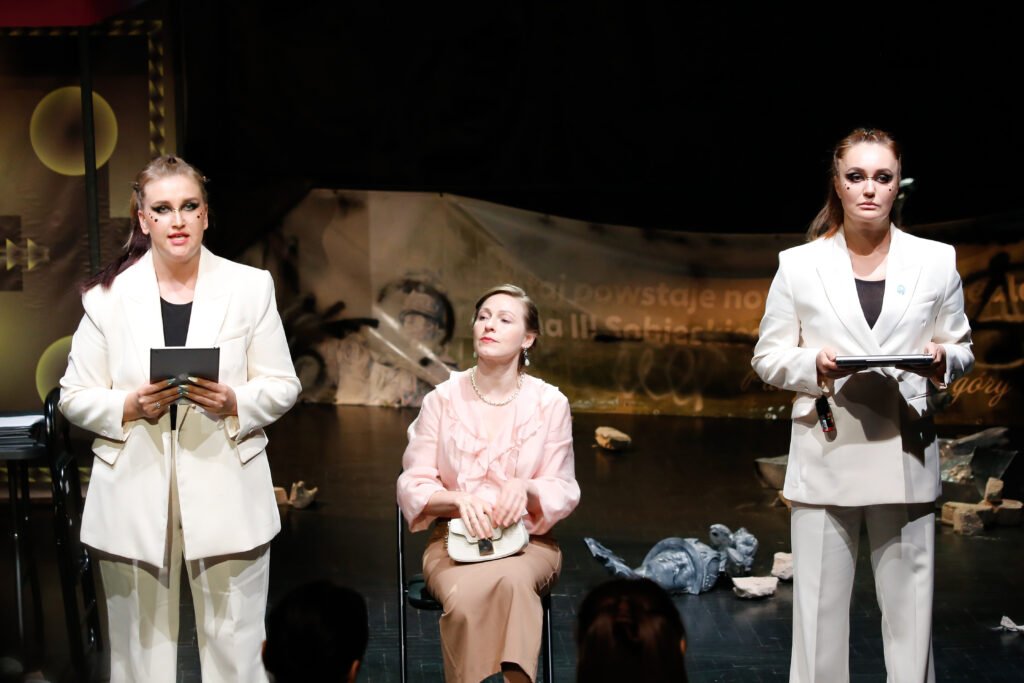
K. K. Although the discussions during the Druga Próba–2025 festival were attended not only by Belarusians, they still found points of contact — perhaps not with our pain, but with their own experiences and traumas.
V. M. That is exactly what means a text is good: it has volume. It is non-local — unlike plays that work only within our context.
Creating a space for plays to be heard
K. K. Let’s move on to talking about the Dramatyzacyja’25 festival. How did the idea of creating it come about?
V. M. I work with playwriting on a permanent basis; we started the Druga Próba festival, and we realised that we need texts, but it was hard to reach them. That is precisely what became the main motive for launching the Dramatyzacyja festival.
K. K. Tell us about the key rules for taking part in the competition.
V. M. It’s a competition for playwrights who identify as Belarusian, regardless of place of residence and language of writing. This year texts are accepted in Belarusian, Russian and Polish.
The participation of authors who are in Belarus is fundamentally important to us, so anonymous participation or participation under a pseudonym is provided for — names are not disclosed without the authors’ consent, including when the results are announced.
First a longlist of ten plays is formed, then a shortlist of five. These texts will be presented as part of a two-day festival of performative readings. The winner will receive a cash prize of 1,000 euros. In early February we will open an open call for directors. The main goal of the competition is for Belarusian playwriting to be heard from the stage.
Waiting without fear
K. K. Do you expect a large influx of plays to Dramatyzacyja’25? For comparison: 28 plays were submitted to the first WriteBox, and 73 to the last. Now 35 texts have been submitted to Dramatyzacyja, even though submissions haven’t closed yet.
V. M. Within WriteBox that was an important victory not only in a quantitative but also in a qualitative sense: the texts grew stronger and more significant year by year.
Now there’s very little time left until the deadline, and we already have 35 plays — and that, without doubt, is gratifying. At the same time it’s important to understand that we accept texts written since 2020, that is, over a five-year period. I’m genuinely curious how many plays there will be in the end — and what they will turn out to be.
K. K. Probably the last question — about you and your feelings. How do you feel inside this process, understanding all the difficulties in which we now exist?
V. M. I feel a purpose and a support in the team. I have no fear that something will fall through: everyone does their own job, and there’s no sense of catastrophe.
Belarusian theatre, which we built over years practically without resources, is very important to all of us. And now I see a readiness to give it our utmost — that’s why I’m sure everything will work out.