Theatre out of necessity: how Dramatyzacja was born
The first competition-festival Dramatyzacyja’25 appeared not as an abstract initiative but as a response to a concrete need — a need for texts and for a voice. The competition’s director and artistic director, Valiantsina Maroz, recounts that the idea grew out of practice:
“I began to work more closely with playwriting, the Druga Próba festival appeared, and we suddenly realised: we lack texts. And not because there aren’t any, but because they’re hard to reach. That’s how Dramatyzacyja was born.”
From the very beginning the competition sets broad but principled frameworks. Authors who identify as Belarusian — regardless of their country of residence and language of writing — are invited to take part. In 2025 plays were accepted in Belarusian, Russian and Polish.
A particular emphasis is on the safety of participants from Belarus. For them the possibility of anonymous participation or the use of a pseudonym was provided: the authors’ names were not disclosed without their consent, even at the stage of announcing the results. In today’s conditions this is not a formality but a necessity.
From text to stage: the mechanics of the competition
The structure of the competition has several stages: first a longlist of ten texts is formed, then a shortlist of five. It is precisely these plays that become the basis of a two-day festival of performative readings. In early February a separate open call opens for directors, who then work with these texts.
The main goal of the competition was formulated precisely and ambitiously — to return playwriting to the stage:
“It’s important to us that Belarusian playwriting be heard. That these be not just texts, but living theatre,” Valiantsina Maroz emphasises.
In its first year of existence the competition gathered 66 submissions — and that on the condition that only plays written after 2020 were accepted. Thus we are talking about topical, “fresh” playwriting of the last five years. Behind the scenes of the project is a team that Maroz calls her main support:
“I have no fear that something will fall through. Everyone does their own job. For all of us Belarusian theatre is something we built over years almost without resources. And now I see a readiness to give a hundred percent.”
The jury included the playwright and director Yulia Khalevinska, the theatre researcher Kseniya Knyazeva, the director Andrei Novik, and others.
The festival took place thanks above all to the support of the German Marshall Fund, as well as the MOST VI mobility programme administered by the Goethe-Institut in Vilnius, the Liderzy Przemian foundation as part of the post-fellowship activities of the Lane Kirkland Program with funds from the Polish-American Freedom Foundation, and the Warsaw venue Dom w Alejach, where the festival’s staged readings took place.
New playwriting: voices and tendencies
Out of the 66 submitted texts, ten were selected — the longlist, which already gives a sense of the thematic and stylistic diversity of contemporary Belarusian playwriting.
Longlist:
- “The Red Squirrel” by Khasia Korneva;
- “Limbo” by Renata Talan;
- “The Realest” by Kseniya Shtalenkova;
- “Flowers” by Tutaka;
- “The Last Witness [of Old Hrodna]” by Amaliya Ryznich;
- “How to Get Rid of Shame, or Unlove” by Zhenia Davidzenka;
- “The Fern Flower” by Renata Talan;
- “Any Place Where Traces Remain” by Maryia Bialkovich;
- “From the ‘Dialogues’ Series” by Uladzimir Sachkouski;
- “Vyrai” by Taina Ramanava.
The shortlist comprised five plays, which were presented in the format of staged readings:
Shortlist:
- “The Red Squirrel” by Khasia Korneva;
- “Limbo” by Renata Talan;
- “The Realest” by Kseniya Shtalenkova;
- “The Last Witness [of Old Hrodna]” by Amaliya Ryznich;
- “Any Place Where Traces Remain” by Maryia Bialkovich.
The gender composition of the competition also deserves separate attention: the absolute majority of the longlist plays and all the shortlist works were written by women. This is no longer a coincidence but a clear tendency, testifying to the gradual feminisation of contemporary playwriting.
The reasons here are obviously not unambiguous. On the one hand, this may be connected with the material conditions of the profession itself, which rarely guarantees stability and therefore more often attracts those who are ready to work in more precarious conditions. On the other — and this is perhaps more important — women’s voices that for a long time remained on the periphery, or were not heard at all, are sounding ever more strongly.
Today these voices are not merely present — they shape the agenda, propose new themes, intonations and optics. And it is precisely thanks to them that contemporary playwriting looks more diverse, more attentive to details and inner states, more sensitive to the complexity of human experience. In this sense Dramatyzacja-2025 records not only new names, but a shift in the very structure of the cultural conversation.
Memory, trauma, testimony: texts and staged readings
A separate place on the shortlist is occupied by the play “The Red Squirrel” by Khasia Korneva — a documentary text built on the real testimonies of women whose stories formed the basis of the dramatic fabric. The play unfolds as a mosaic of voices: fragments of recollections, personal confessions, of experience that often remains unspoken. There is no traditional plot here in the classical sense: instead there is a living stream of human stories in which trauma, shame, vulnerability and the attempt to reclaim one’s voice are interwoven. The documentality of the text works not as a backdrop but as the main principle: this is not “about someone,” but directly “on behalf of someone.”
It was precisely this that manifested itself especially strongly during the staged reading. The women whose stories formed the basis of the play were present in the hall. And this presence radically changed the perception: theatre at that moment was not only a space of convention. The words sounding from the stage had concrete bearers — living, real, here and now.
This created a rare effect of the coincidence of the document and its witness, when the distance between text and reality almost disappeared. As a result, the reading turned not only into an artistic event but also into an act of jointly living through experience — for the viewers and for the participants themselves. The play “The Red Squirrel” was staged by a team under the direction of Aleksander Jędrzejewski.
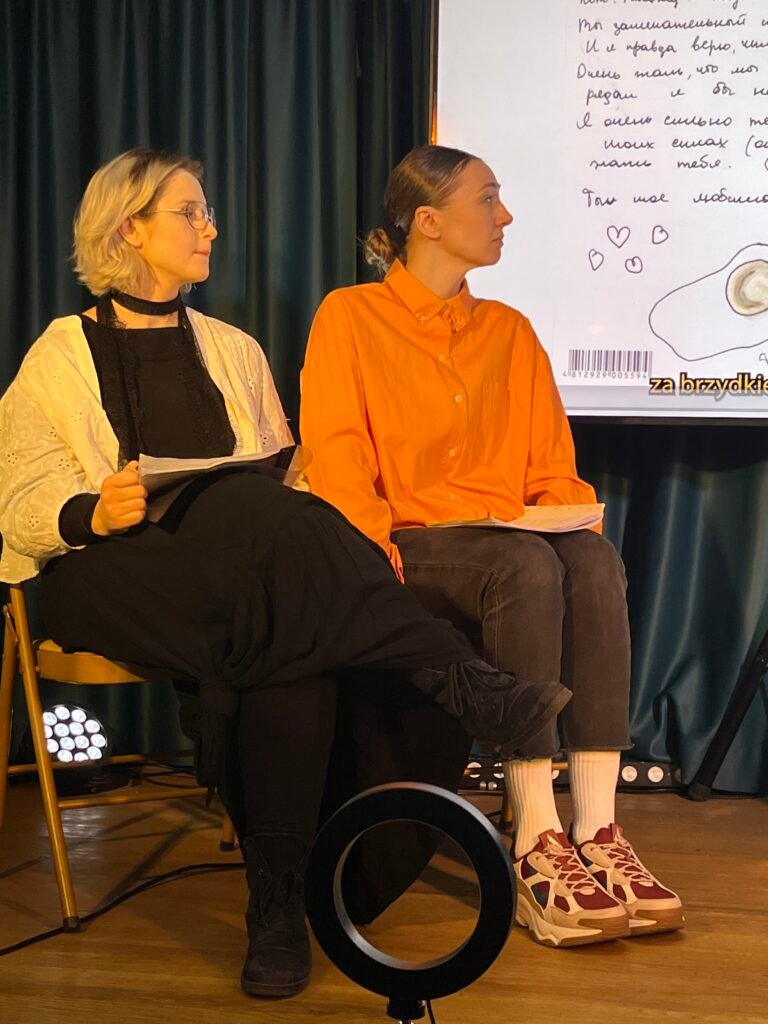
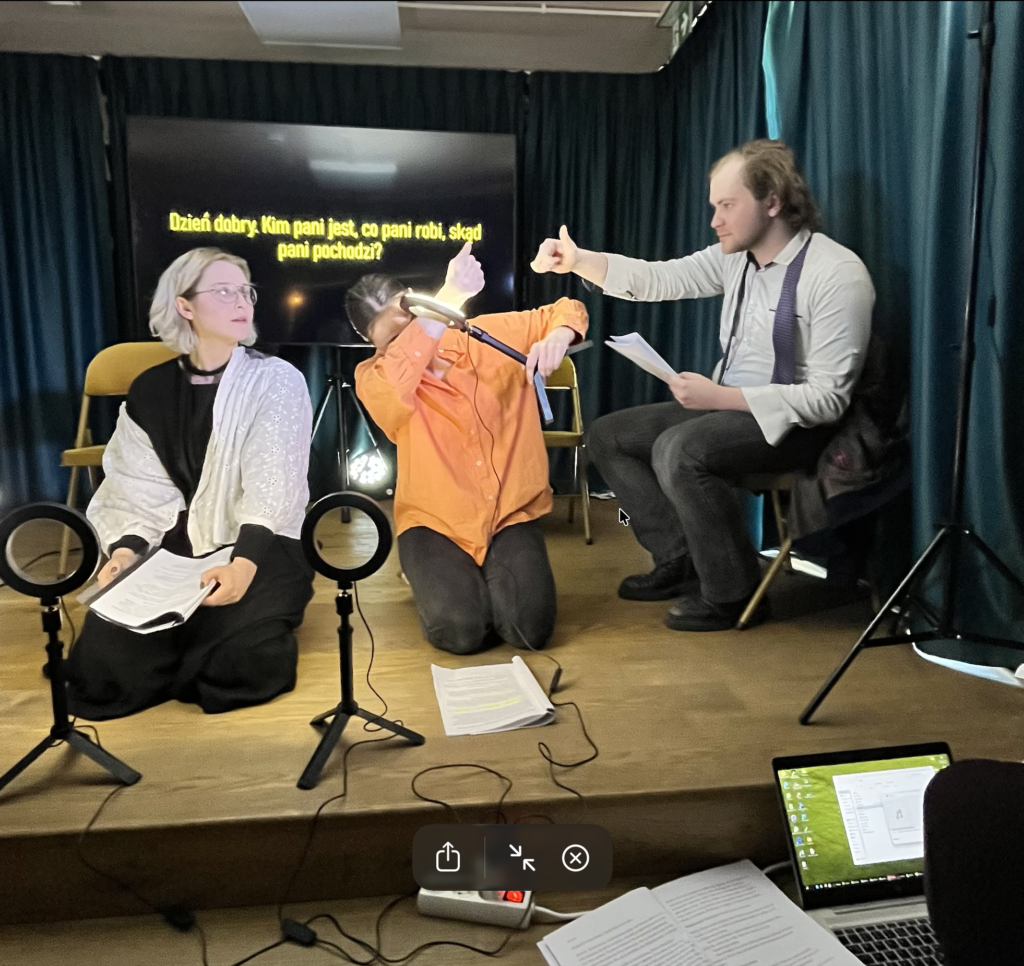
A team led by the same director also presented a reading of the play “The Last Witness [of Old Hrodna]” by Amaliya Ryznich. In the play the theme of memory and heritage plays an important role. The text is about the activist work of independent journalism in Belarus. The work is based on the real story of the journalist Raman, who recorded residents’ recollections of life in Hrodna in different eras. After the 2020 presidential election he tried to show what was happening in his home city, and paid a cruel price for his civic participation in political events.
The author deliberately builds parallels between the events of the most recent history and the period after the annexation of Western Belarus to the USSR in 1939, when part of Hrodna’s residents expressed active resistance to the entry of Soviet troops. These pages of history long remained outside the official narrative or were deliberately distorted. The same danger — of silencing, of manipulating memory and creating a selective historical version — is obvious with regard to the events of 2020 as well. And how they will be remembered in the future depends to a significant degree on us, the witnesses and participants of the present.
In the staged reading the emphasis was placed on the story of the particular journalist, and more broadly, on how memory is preserved under conditions of totalitarianism, where the past easily lends itself to editing, and journalism inside the country gradually degrades into “vegetarian” formats stripped of sharpness and responsibility.
Although, by the director’s own admission, the work on the text was not easy — above all because of the difficulty of the theme itself and the need to find a balance between documentary precision and scenic expressiveness — in the end it was precisely the characters who became the centre and the main driving force of the reading.
This manifested itself especially vividly in the line of the so-called “couch troops” — a couple, a husband and wife, who at first exist in a mode of remote observation. They comment, evaluate, consume information, but do not truly engage with it. Their position is one of distance, comfortable and safe.
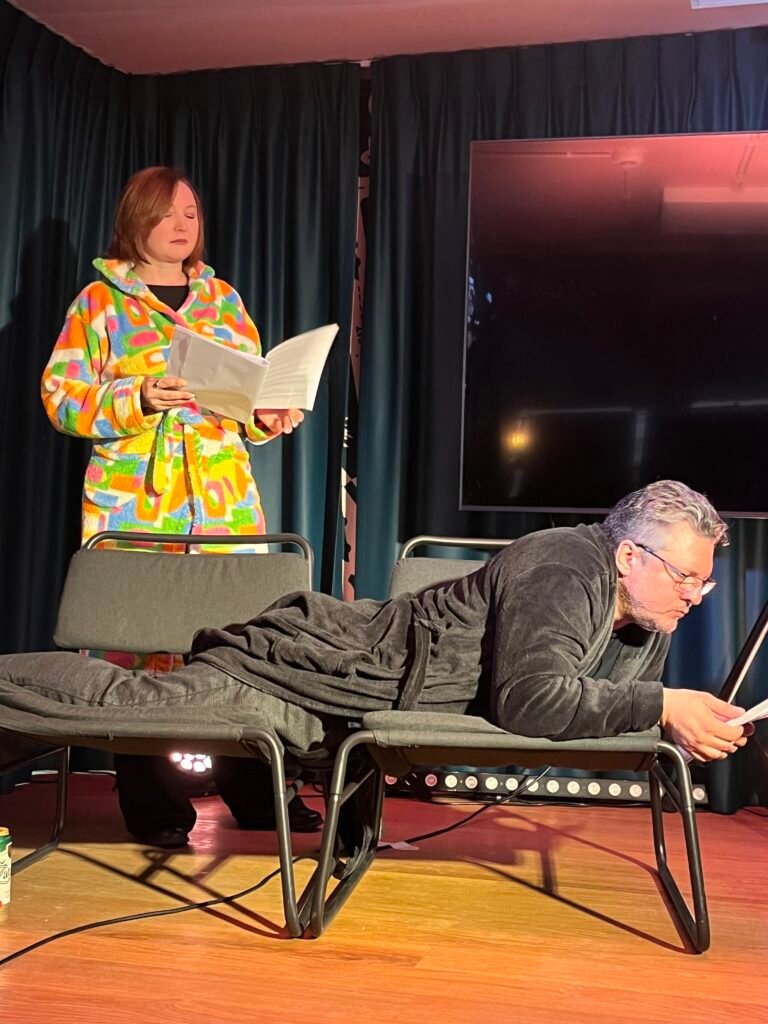
Yet gradually, within this distance, it is precisely in the male character (Demetriusz Kochański) that a shift takes place. Under the pressure of facts, testimonies and another’s pain, he undergoes his own transformation from an indifferent observer into a person who can no longer remain on the sidelines. The moment of realising the truth is presented here not as a sudden revelation but as a process — slow, resistant, but irreversible. While the female character stays with her own views, and even hardens further still. It is especially interesting that the same actress (Julia Katarzyńska) plays the role of the Mother of the main character, drawing attention to herself. She is an ardent supporter of the current regime, who on a superficial level expresses incomprehension and even indignation at the actions of those who resist. Her gaudy, tasteless house clothes and a cunningly malicious gaze that seems to say, “I know — you’ll all still get what’s coming,” create a vivid contrast.
It was precisely through these characters that the reading gained an additional level: they turned into a kind of mirror for the viewer, offering not a ready-made moral but a situation of recognition. And in this sense their presence proved no less important than the documentary material itself — because it allowed one to see not only the story, but one’s own possible reaction to it.
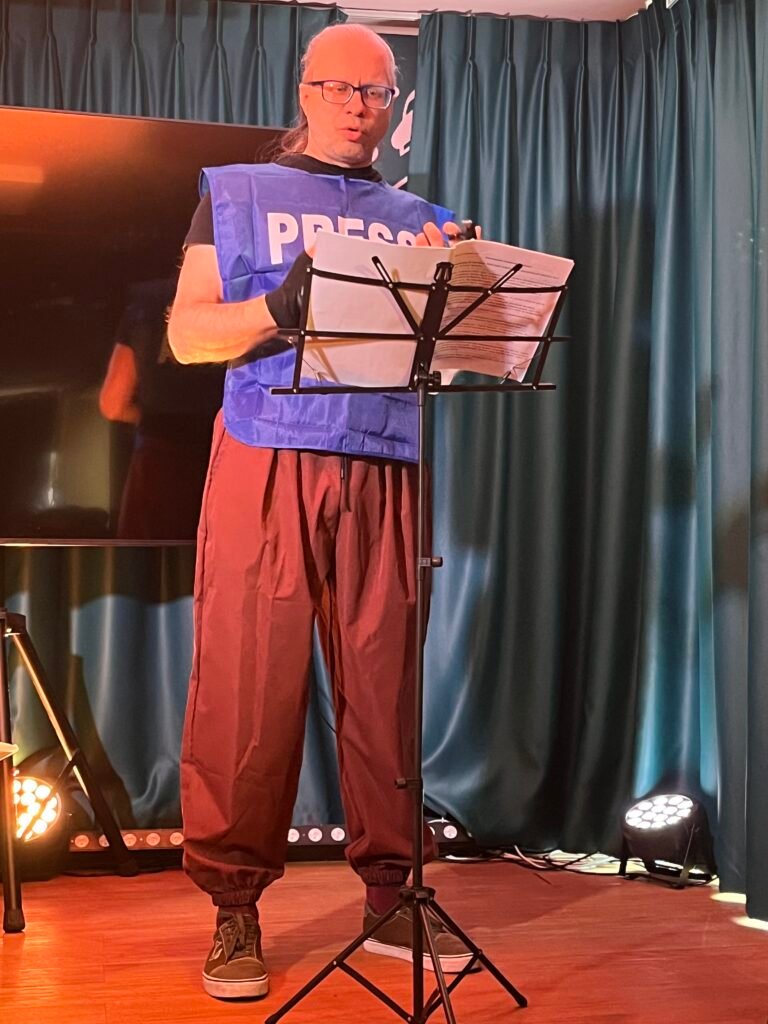
Maryia Bialkovich’s play “Any Place Where Traces Remain” is a meditation on memory, trauma and oblivion, on how (and whether it is possible at all) to preserve memories of violence. At the centre of attention is not only the personal story of the heroine, but also collective memory, which is gradually eroded under the pressure of fear, propaganda and the habitual desire “not to get involved.”
The author touches on themes that sound especially sharp in the Belarusian context: violence and silence — both literal and symbolic; experience that does not lend itself to language; the elusiveness of national identity; the transformation of another’s pain into a media spectacle; and she also touches on the theme of internal colonisation and the loss of one’s own voice.
The main heroine’s amnesia here is not simply an individual trait but a mode of existence. Her words “I don’t remember” sound like a formula of self-defence — but at the same time like a metaphor for a broader state in which society finds itself when it loses its connection with its own history, roots and responsibility.
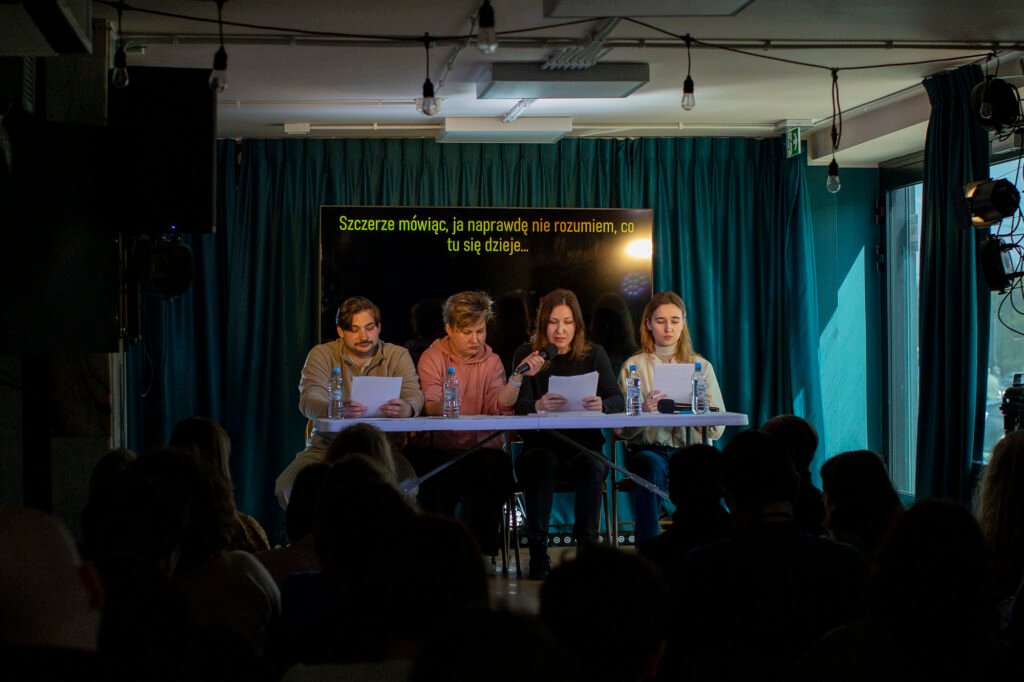
Director Bazhena Shamovich consciously focused on the art of acting: a minimum of means and a maximum of expressiveness — four strong acting performances and a talented text that, in the performance of the actors Sviatlana Tsimokhina, Aliaksei Saprykin, Maryia Piatrovich and Palina Chabatarova, sounds anew. This staged reading does not try to replace a full production — on the contrary, it underscores the very nature of word and presence, when everything is held together by intonation, pause, gaze and a precisely found rhythm.
The actors do not “illustrate” the text but enter into a living conversation with it: they change roles, voices and tempos, as if translating it from the written language into the language of the stage. Thanks to this, familiar meanings acquire an unexpected volume; new accents and half-tones appear. The work with the pause is especially palpable — silence here sounds no less expressively than words.
There is a lot of humour in the production, but it does not relieve the tension; rather, it underscores it: laughter arises as a reaction to pain, as a way of enduring what is said and heard. This humour is precise, sometimes almost uncomfortable, and therefore all the more apt.
As a result, a concentrated, almost ascetic form emerges, in which nothing distracts from the main thing — from the viewer’s encounter with the text through the actor. And it is precisely in this simplicity that the staged reading reveals its strength: it does not impose interpretations, but insistently invites one to listen and to listen closely.
In the text, different cultural and linguistic layers are interwoven — Belarusian, Ukrainian, Jewish, Polish. They manifest themselves through language, folklore, humour and songs, forming a complex fabric of memory. And from this interweaving a key question arises: who are we — and whose traces do we actually carry within ourselves.
Body, pain and light: intimate stories on stage
Kseniya Shtalenkova’s play “The Realest” is that rare case when, through physical pain, vulnerability and a tense search for one’s place in the world, something unexpectedly luminous breaks through. It is built as the confession of a girl with a disability — but it is not so much a story about “difference” as about the experience of a woman who must daily overcome not only her own limits but also the constraints the world imposes on her.
The heroine’s voice sounds sincere, defenceless, sometimes even uncomfortably truthful. In this text there is no attempt to conceal or soften reality: on the contrary, it looks at the world almost without illusions, as if constantly holding in mind the thought that catastrophe may happen at any moment.
And it is precisely against this backdrop that one feels especially strongly that very “ray of light.” It does not look naive or artificial — it is hard-won, suffered for. It appears not in spite of the pain but together with it, as its continuation and at the same time its overcoming. This ray does not illuminate everything around, does not give ready answers, but touches the innermost — and remains.
From this touch arises a feeling that is hard to name unambiguously: it is both pain, and tenderness, and a strange clarity. As if a scar remains inside — glowing, alive. It hurts, but at the same time it reminds one of something very essential: of the possibility of hope even where, it would seem, it should not be. This is the strength of the play — it does not try to evoke pity through the theme of inclusivity, but speaks on equal terms, inviting one into an experience that is universal at its core. And that is why it resonates so painfully and precisely.
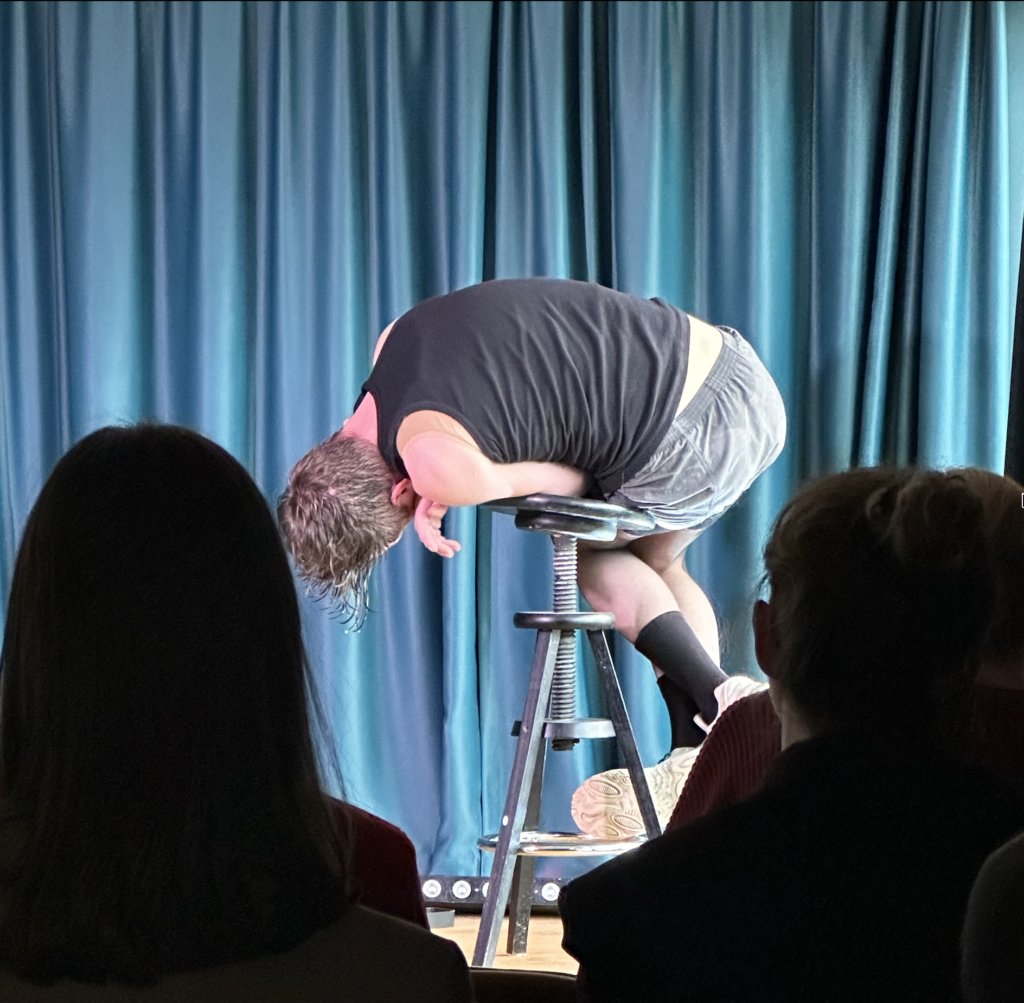
The staged reading directed and performed by Kiryl Masheka turned into an independent performance, where word and body existed as if in a tense dialogue. The text sounded in a recording — powerfully and emotionally — while on stage a maximally physical, even painful presence unfolded.
The performer consciously placed himself in discomfort: awkward, forced postures became not just a visual device but a way of living through and conveying the heroine’s state through the body. He tried to put on boots standing at the front of the stage, but his own posture made it utterly impossible; for a long time, with evident difficulty, he climbed onto a high chair, turning this simple movement into a genuine ordeal.
The culmination came at the moment when, having finally reached the top, he remained there exhausted, on the edge of his strength: sweat ran from his hair and fell to the floor like tears. In this physical extremity a special truth arose — pain ceased to be only a theme of the text and became visible, almost tangible.
As a result, a powerful contrast was born: the voice as an inner monologue, and the body as its material embodiment. And it was precisely in this divergence, in this tense asynchrony, that the staged reading acquired its expressiveness and strength.

Between worlds and words: the festival’s winner
An important event of the festival: the announcement of the winning play; by the choice of the jury members it became “Limbo” by Renata Talan. The play develops an artistic exploration of the consequences of the events of 2020 in Belarus, but does so through a sharp, surrealist angle. The text reveals the heroine’s life in an intermediate existential state, where natural human ties are destroyed and the future loses its clear outlines. After the events of 2020 the Woman loses her job, her friends and loved ones, who are forced to go abroad; her connection with them exists only in the form of correspondence. With the dead, on the other hand, she enters into direct, absurd-ritualistic interaction: she organises funerals for those whose relatives cannot return to Belarus. Thus the plot and metaphysical structure of limbo is built — a place between life and death, where the heroine finds herself between people, between worlds, between her former self and her present self.
In the production of “Limbo,” the choice of the performer of the main heroine immediately draws attention: the role is played by the Ukrainian actress Lalita Zhuravlyova, and despite her confident command of Belarusian, her foreignness is nonetheless palpable. This nuance works not as a flaw but as a precisely found artistic device. Director Zhenia Davidzenka seems consciously to lead the story away from a narrowly national reading, expanding it into an experience that goes beyond the bounds of a single country or context.
Such a linguistic shift gives the image an additional layer — the heroine sounds like a person not fully rooted in the space she is in. And this very precisely echoes the very nature of the play: it exists in a state of borderland, in that very “limbo” where the boundaries between the personal and the collective, the past and the present, life and ritual are blurred.
In this context the stage ceases to be a simple illustration of the text — it materialises the very experience of timelessness with which the play is saturated. The heroine becomes not only the bearer of the story but also its space: her body, voice and intonations embody this state of “in between.”
Her image fits organically into the limbic space: she is the one who has lingered in a transitional state and is forced to exist between duty and personal pain, between living feeling and professional function. The absurdity of her role as a “mourner” only reinforces this effect — weeping that ought to be sincere turns into part of the job, and therefore loses its grounding in naturalness.
As a result, a powerful image arises of a person deprived of any ultimate belonging — neither to a language, nor to a place, nor to their own experience. And it is precisely this unsettledness that becomes the key to understanding the entire staged reading.
A space of living conversation
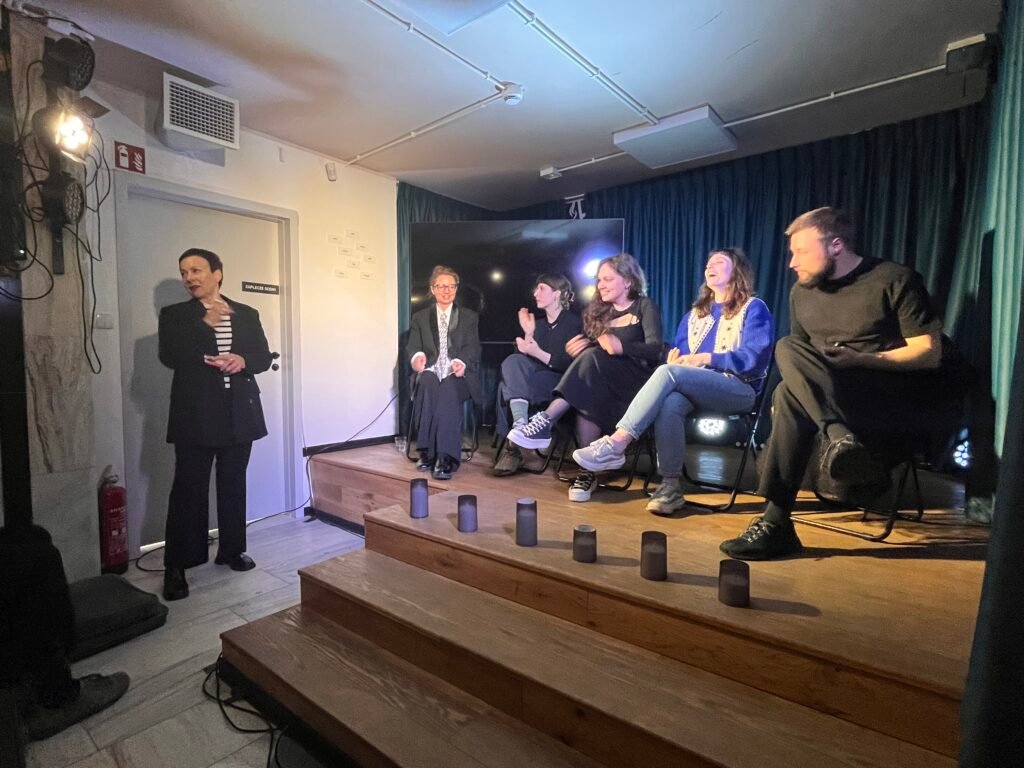
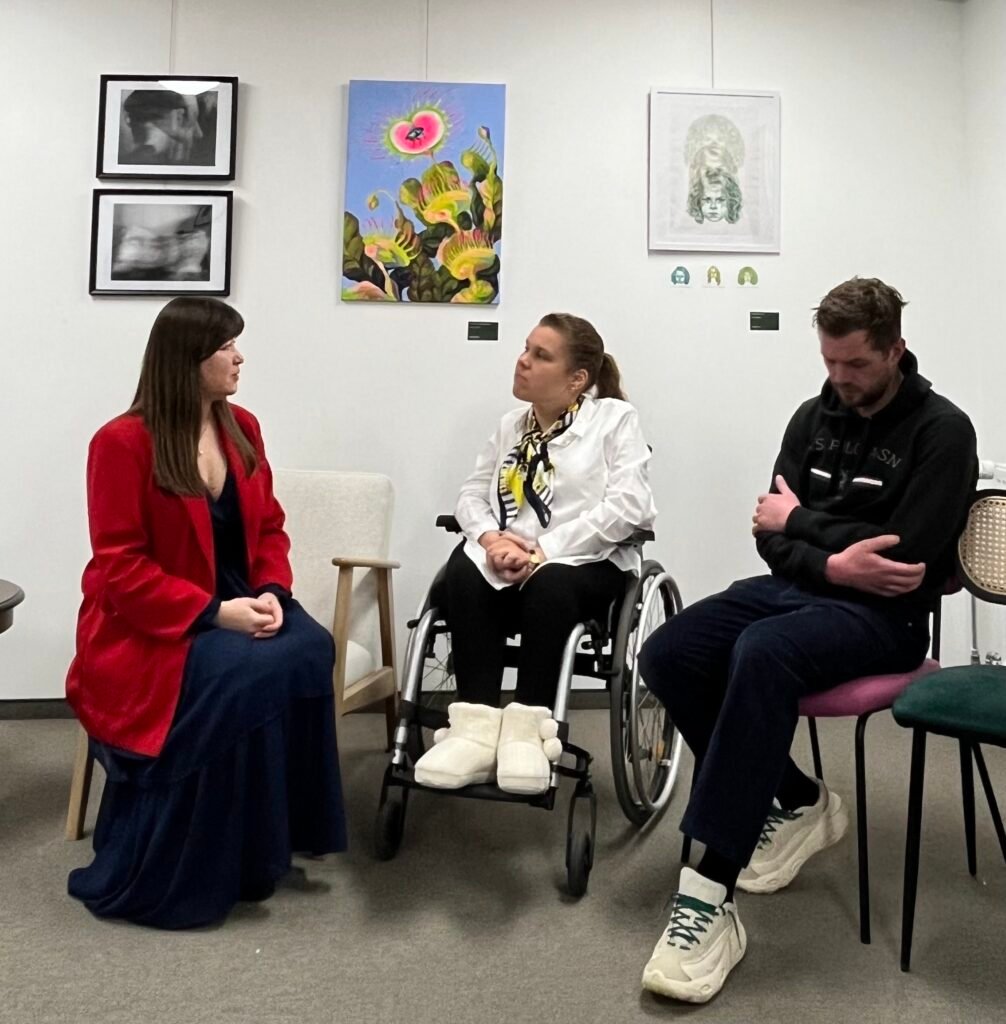
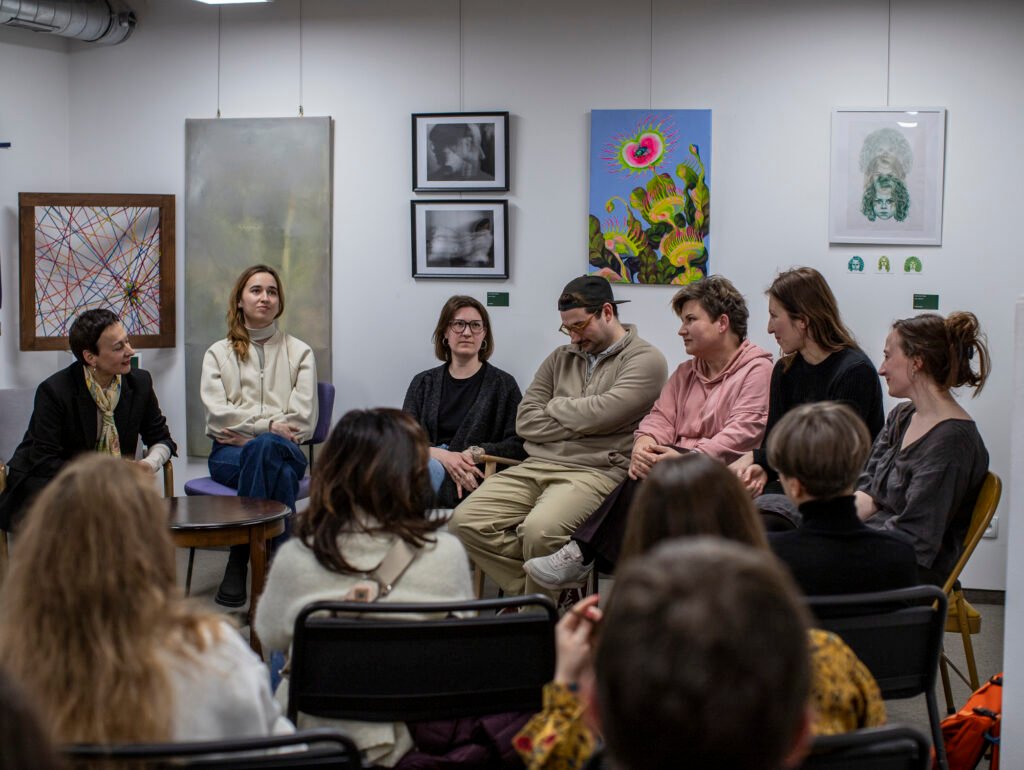
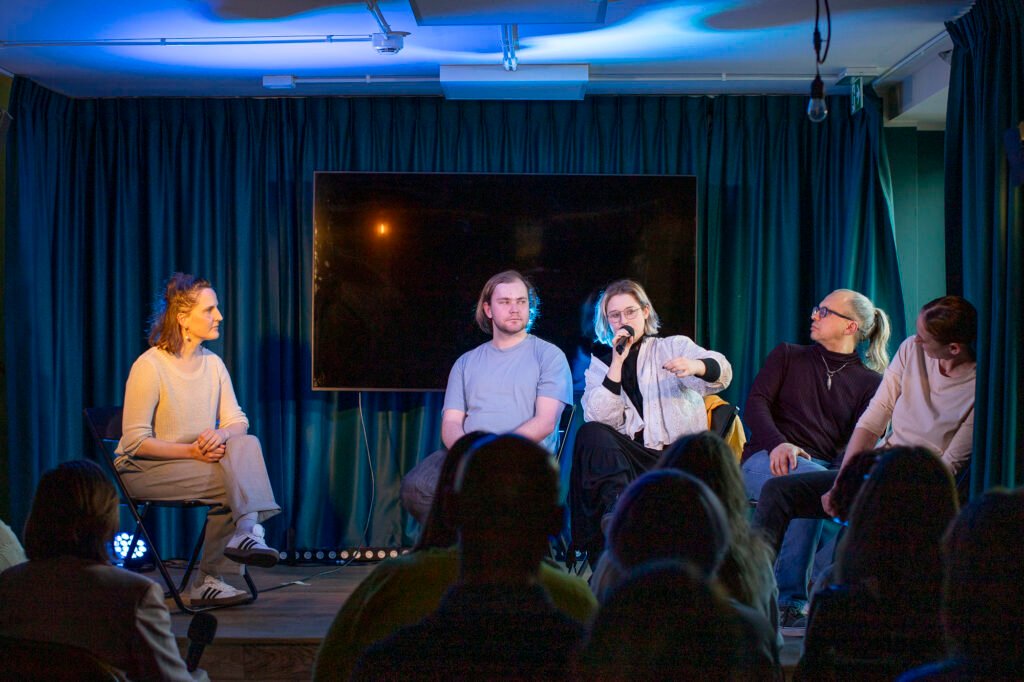
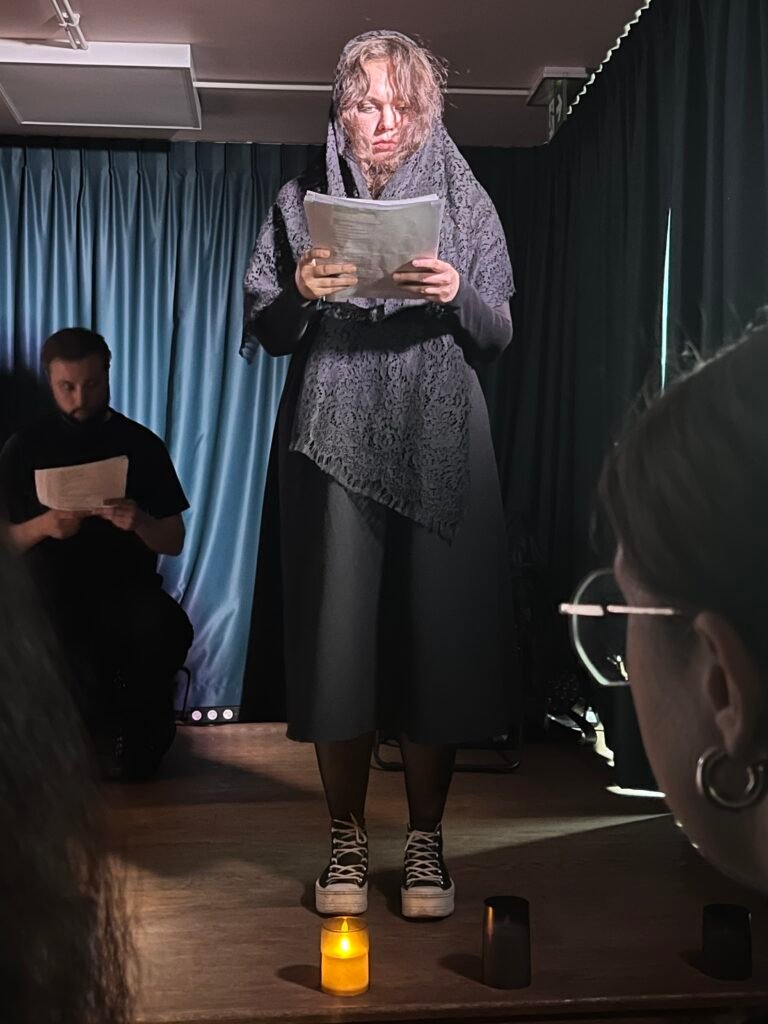
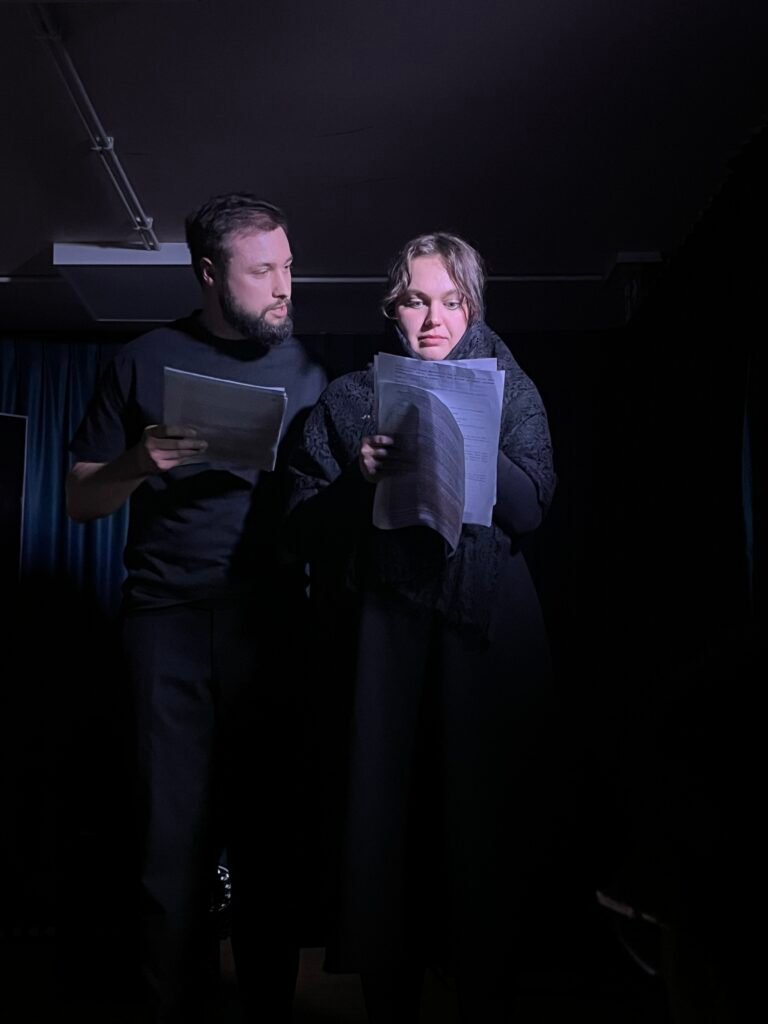
After each staged reading there were open discussions with the participation of the authors, directors and actors (the discussions were moderated by the theatre researchers Kseniya Knyazeva, Natalla Valantsevich, the director Aliaksandr Marchanka, and the directors Valiantsina Maroz, Natalla Levanava). This was not a formal “add-on” to the programme, but a full-fledged part of the festival process: a living, energetic conversation in which interpretations clashed, meanings were clarified and new readings were born. The involvement of the viewers was especially palpable — the questions were precise, sometimes sharp, and it was obvious that interest in contemporary Belarusian playwriting was not declarative but sincere and thoughtful.
In general, the viewers’ interest became one of the key indicators of this event: full halls, attentive silence during the readings and activity afterwards underscored that such a format is needed and timely. The Dramatyzacja-2026 competition recorded not just individual texts, but also a demand for conversation — about language, experience, the present and how all of this can exist on stage.
In this sense the competition looks not like a one-off initiative but like an important element of the cultural process, one that forms a field for new playwriting and its encounter with the viewer. And the fact that the organisers plan to hold it once every two years sounds like a promise of continuity — and, no less importantly, like a responsibility. It remains to await the next Dramatyzacja-2028 and to observe how this space will develop — it is already obvious that it has the potential to become one of the key points of attraction for contemporary Belarusian theatre.